

Table of Contents
Volume I of The Conopticon Papers
By Amanda Breeze
This series promises to expose the silent mechanisms that shape our daily lives through familiarity rather than force. If you’re a parent navigating the complex paths of homeschooling or someone questioning the norms dictating educational choices, these insights will resonate with you. Beyond education, these themes are relevant to anyone who has pondered the dynamics of conformity and control in our society.
In The Conopticon Papers, I explore how decentralized surveillance, social judgment, and bureaucratic conformity have quietly replaced institutional authority. This is not Orwell’s dystopia. It’s the neighbourhood watch gone algorithmic, the school registration form with 42 pages, and the smiling neighbour with a phone. Take, for instance, the local community app where members, driven by both concern and curiosity, can report unusual activities in their area. These reports, often algorithmically analyzed for patterns of behaviour, can quickly escalate common activities into points of suspicion. This digital layer of monitoring transforms a simple neighbourhood stroll or midday outing into a data point that feeds the broader network of informal surveillance.
From parenting and education to digital life and identity, each volume dissects how control no longer requires coercion; it only requires compliance.
This series is part memoir, part cultural diagnosis, part philosophical provocation. It is for anyone who has ever felt watched, flagged, or measured not by who they are, but by how well they fit.
Volume I begins where some of us do: with our children, and the systems that claim to know what’s best for them.
We were in between places. Not homeless and not yet home. We were suspended in a bureaucratic purgatory that families know all too well. Ours was the kind of instability that isn’t dramatic enough to warrant assistance, but just precarious enough to endanger your credibility. A volatile job market has led to unstable employment and caused uncertainty in maternity leave. A ruthless housing market made permanence a fantasy. Our address was borrowed, our routines were fragmented, but school registration demanded certainty. It demanded proof, performance, and presence.
We adapted. We made quiet arrangements with landlords to use their addresses. We used libraries and community centers as makeshift classrooms. We crafted a rhythm where there was none. Amid the impermanence, we gave our daughter something close to a childhood.
She was seven.
Enrolled in a system that would have placed her in three different schools within a year: three classrooms, three sets of teachers, three identity resets before she could even spell “stability.”
I was told to comply. But I saw the cost.
So, I pulled her.
Not out of fear. Not out of rebellion. But from the most unremarkable and profound form of love: consistency. If I couldn’t give her a permanent home, I could give her a steady rhythm of days. If her world were unstable, I would not let her spirit fracture to match it.
This is the part they never tell you: sometimes it’s not the system you’re protecting your child from, it’s the instability the system normalizes.
But the moment I chose to homeschool, the spotlight turned.
The Conopticon Begins
In today’s world, opting out of normative practices, like public education, is often mistaken for radicalism. To homeschool is to deviate. And deviation invites scrutiny. In many regions, provincial and state statutes classify homeschooling under a special regulatory framework, which often subjects it to stricter oversight compared to conventional schooling methods. This systemic coding of deviation as something to be closely monitored illustrates how deeply entrenched these norms have become in policy, not just culture.
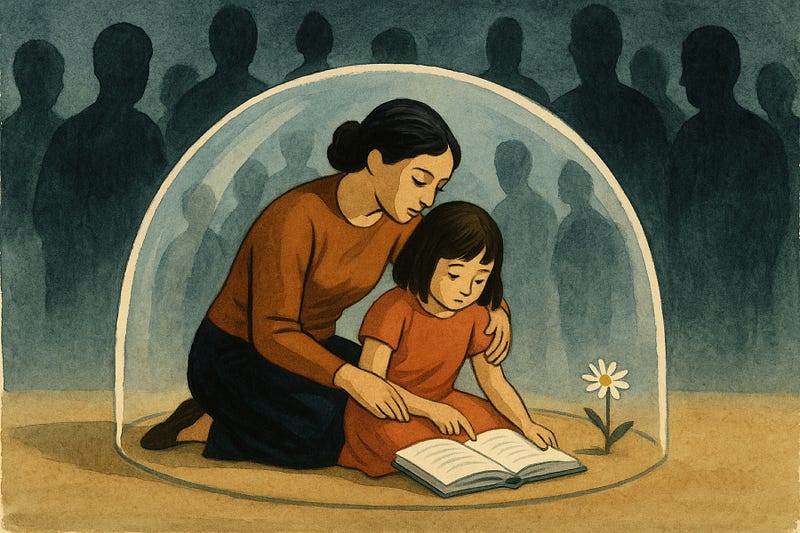
When you remove your child from school, you become more than a parent. You become a person of interest in a decentralized surveillance network. At the center of this network is The Conopticon: a system not powered by top-down state observation, but by peer enforcement. It is not Big Brother. It is every brother.
Apps track absences. Facebook groups flag thoughts. Well-meaning neighbours become deputized agents. A single midday trip to the grocery store can become an entry in an unofficial case file.
The day it crystallized for me, my daughter and I laughed on the park swings. A neighbour I barely knew raised their phone, not to capture a memory, but to document a deviation. Moments later, a casual message made its way back to me:
“Hey, just checking in. Saw you outside earlier. Not much schooling going on?”
That one photo wasn’t just a picture. It was a data point. A digital whisper that could trigger a knock.
A hive of surveillance: decentralized, polite, and devastating.
Recent studies have shown a rise in peer-to-peer reporting in education and child welfare over the last five years. According to a 2022 analysis by the National Education Monitoring Authority, the number of these reports has increased by 35% since 2017. Many reports originate not from educators, but from acquaintances. The ‘concerned’ class.
For families, the knock on the door arrives not as a gesture of support but as an inquiry fueled by this quiet observation, transforming their everyday life into a tableau of caution and discomfort. This increase translates into countless stories like mine, where the echo of concern reverberates through the corridors of homes trying simply to exist in quiet harmony.
And not long after, the calls began, not from the school board, but from Children’s Aid Services.
When “Concern” Becomes Control
One ping. One file. One phone call.
They say it’s out of concern. However, in the Conopticon, concern is currency. It is surveillance in soft clothes.
If I were wealthy, I’d be “worldschooling.”
If I were upper-middle-class, I’d be “nurturing independence.”
But because I’m neither, I’m flagged.
An inconsistent address, no fixed school, and self-directed learning are not problems in themselves, but they become red flags because of who is waving them.
The Conopticon doesn’t punish failure.
It punishes the very strategies low-income families use to survive.
The Illusion of Choice
I did not withdraw my daughter to isolate her. I withdrew her to shield her from fragmentation. An endless rotation through institutions that see her as a file, not a person.
This wasn’t ideology. This was triage.
But once you exit the system, it refuses to release you. You’re no longer evaluated as a parent; you’re auditioning for credibility.
Your child becomes your proof:
Are they advanced enough?
Are they socialized enough?
Are they normal enough?
While the state will not invest in supporting families who stay, it will allocate generous resources to scrutinize families who leave.
A Curriculum of Conformity
The school I left behind no longer felt like an educational institution. Fiction became optional. Vocabulary gave way to feelings. Books were tiered not by complexity, but by the number of illustrations.
Critical thinking didn’t evolve: it evaporated.
Students once read Steinbeck and Austen. Now, graphic novels dominate, and short stories masquerade as literary depth. This shift isn’t simply regression or dilution of rigour; it’s a reflection of evolving educational priorities. Graphic novels, in particular, have the potential to engage visual learners and foster critical thinking through their complex narratives and illustrations. However, this doesn’t negate the importance of classic literature, and ideally, they should complement rather than replace established works. Some innovative programs successfully integrate classics with graphic texts, aiming to create a richer, more well-rounded curriculum that embraces both tradition and new forms.
This isn’t nostalgia, it’s documented. The rigour is dissolving.
Meanwhile, outside the system? Wonder still breathes.
We’re told it’s progress, and we’re told it’s trauma-informed. But what I see is compliance masquerading as care.
I pulled my daughter not to isolate her, but to keep her whole.
A Sideways Surveillance State
The Conopticon is not Orwellian. It is not a tower. It is a cul-de-sac, looped like a never-ending neighborhood watch, wrapped around our lives. Rather than a singular, imposing structure, it spreads through digital architectures, feeds, and timelines that encourage us to broadcast our every move. This interconnected grid subtly reinforces sideways surveillance, amplifying conformity not only through what we see but also through what we share.
It’s not officials with binoculars. It’s fellow parents with “questions.”
It’s not coercion from above. It’s conformity from beside.
Judgment doesn’t come from a bureaucrat. It comes from the school council parent who’s never liked your tone. The neighbour who reports “a concern.” The teacher who wonders aloud whether your child is “being challenged enough.”
In the Conopticon:
Visibility is virtue.
Compliance is care.
Stepping out of line, even with reason, becomes a cause for concern.
How I Know
This is not theoretical.
I served on the parent council and held the position of treasurer. I witnessed firsthand how changes like the “book spectrum” were introduced under euphemistic terms and gentle pitches from the administration, never as debates and never with full parental awareness.
Books were quietly sorted by “reader level,” with heavily illustrated books handed to the “low” tier, and text-dense material offered to the “high.” This was framed as inclusion, but it subtly normalized inequality.
The irony?
We’ve spent decades calling the education system too rigid, too resistant to reform. Yet when new practices are introduced under the pressure of social media trends or political urgency, they often bypass the very scrutiny we once demanded.
It seems we question nothing if it comes dressed as progress.
Why I Stayed Out
I didn’t stay out to fight the system.
I stayed out because I remember what education is, and what it is not.
It is not forced socialization.
It is not ideology.
It is not exchanging your child’s spirit for convenience.
Education is curiosity. Dialogue. Challenge.
It’s the sacred awkwardness of not knowing, and the joy of discovery.
One morning, we built a bird feeder together. This wasn’t just a crafting session; it was an exercise in self-directed learning, where autonomy and inquiry were at the forefront. We asked ourselves, “What birds are native to our region?” and looked up the names: Black-capped Chickadee (Poecile atricapillus), Northern Cardinal (Cardinalis cardinalis), and Downy Woodpecker (Dryobates pubescens). We practiced saying their common names and Latin classifications, with her delighting in rolling the syllables like spells. Through this project, my daughter practiced skills that are foundational in established learning science, such as autonomy in choosing what to explore, inquiry through questioning, and collaboration as we worked together.
We explored the question, “What do birds eat?” We compared seed types: millet, sunflower, and nyjer. Then, we traced the origins of the seeds, how they’re harvested, and which species prefer which. We talked about ecosystems, food chains, and the role of winter feeders.
We measured the wood, calculated the spacing, and discussed halves, quarters, and thirds. When our angles were off, we problem-solved, adapted, recalibrated, and tried again.
She used her hands, her mind, her voice. She asked questions that didn’t have answers in the back of a book.
The Conopticon’s Cage
This is not a manifesto.
But if we cannot opt out without punishment –
If education is only valid when state-approved –
If our children are only “safe” when processed –
Then we have not built a public good.
We’ve built a public cage.
And the Conopticon guards it. Not with laws, but with polite suspicion.
I refuse to teach my child how to decorate her cage beautifully.
I will teach her how to walk free.
An Invocation of Sovereignty
Perhaps the most radical act of parenting today is not to fight the system…
…but to step beyond it, in full view, and say:
I will raise my children to be whole,
even if the world no longer remembers what wholeness looks like.
Because true education doesn’t begin with institutions.
It begins with sovereignty.
And sovereignty begins at home.
In light of this, I invite you to reflect on a simple yet profound act of sovereignty that you can incorporate with your child this week. Whether it’s discovering a new book together, exploring a local park, or trying a new recipe, each small step you take in fostering self-directed learning contributes to a stronger, more independent future for your children. Join the conversation: what act of sovereign learning will you share with your family this week, and inspire others to do the same?
Citations & Supporting Sources
- Government of Canada. (2022). Education indicators in Canada: An international perspective 2022. https://www150.statcan.gc.ca/n1/pub/81-604-x/81-604-x2022001-eng.htm
- * Ontario Human Rights Commission. (2022). Right to Read Inquiry Report. https://www.ohrc.on.ca/en/right-to-read-inquiry-report
- * Office of the Auditor General of Ontario. (2022). Value-for-Money Audit: Curriculum Implementation and Student Achievement. https://www.auditor.on.ca
- * CBC News. (2023). Reading recovery programs in Ontario struggle to adapt to new standards.
- * Homeschool Legal Defence Association (HSLDA). (2023). The Changing Face of Homeschooling Regulation in Canada and the U.S.
- * Education Quality and Accountability Office (EQAO). Archived reports and analysis of standardized testing methods in Ontario.


Member discussion