

Table of Contents
What it means to belong in a nation that cannot name you — and how the stories we inherit shape the ones we choose to tell.
I was born in Canada, but I am not solely Canadian.
My inheritance is not singular. It is layered, unresolved, and uneasy.
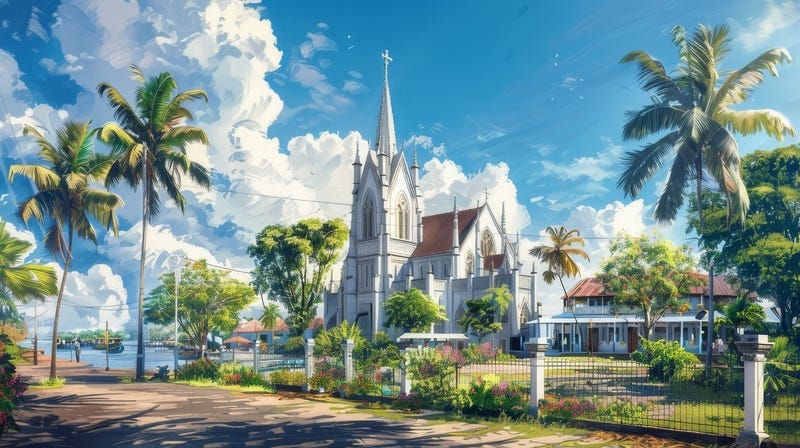
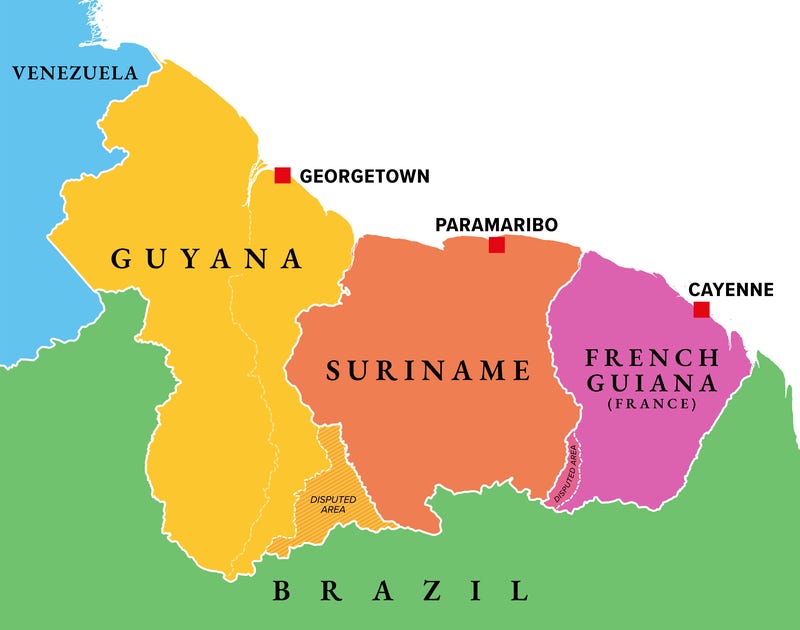
This epic does not begin in any singular place but has a long history of many stories woven together by the act of survival. I begin this journey in a country that many cannot locate on a map — Guyana, a former colonial outpost on the northern coast of South America and the unlikely nexus of the ambitions of five continents.
To describe my identity is to traverse centuries of migration, violence, and compromise. It is to unearth contradictions — personal, political, familial, and ancestral. I accept that I come from both the oppressed and the oppressor.
A Geography of Complexity
Guyana has been claimed many times over. The Spanish arrived first, but their presence was brief. Then the Dutch. The French. Then British. Each colonial tenure left behind a legacy of language, architecture, law, and extractive governance. In their wake came Africans in chains, indentured Indians, exiled Portuguese, Chinese labourers, Syrian merchants, displaced Europeans, and the Indigenous peoples whose lands were already there and whose histories are still untold.
Today’s nation is not so much blended as layered; its diversity is real but stratified. Pre-independence arrangements perpetually shadowed its post-colonial politics. My grandfather was friends with Burnham, who would become Guyana’s first Prime Minister.
Burnham’s rise was bolstered by British and American interests, driven by Cold War concerns about the spread of socialism in the Caribbean. What began as democratic optimism — campaigns of national pride and egalitarian reform — soon gave way to authoritarianism. The promises of populism hardened into surveillance, suppression, and exile. My family, like many others, left the country due to this disillusionment. The revolution was televised, then buried.
Legacy Without Protection
But my family’s story was never entirely outside of power. On my great-grandfather’s side, the line turns toward Suriname, Guyana’s Dutch-speaking neighbour. Little is known about his early life — only that he obtained Canadian citizenship, although no official records explain.

His sister married Vincent Roth, son of Walter Roth, the curator of Guyana’s national museum and zoo, a central figure in the country’s early anthropological and institutional development. His name endures today through the Walter Roth Museum of Anthropology, a rare institution dedicated to the preservation of Guyana’s indigenous histories. Roth rebuilt the museum following a fire in 1945 and founded the Guyana Zoo, located within the Guyana Botanical Gardens in Georgetown. Roth made a significant contribution to Guyana’s cultural and historical identity.
Roth adored his niece, my grandmother. He would treat her as his own. He would have her explore the museum and zoo, gifting her with all sorts of animals, including a monkey, a sloth, and a stuffed leopard. This connection placed my grandmother adjacent to the foundational shaping of the nation — but not within it. Her proximity to politics, history, and culture did not shield her. Her home was not one of privilege but of nearness to it.
My grandmother, the child of a Black mother and a Dutch-Surinamese father, was born into contradiction. Red hair like embers, skin the color of steeped tea, freckles like constellation dust — features that destabilized others’ assumptions. Strangers would accuse her mother of being a nanny. Or worse. They would sneer at her mother in markets and parlours — accuse her of theft, of deceit, of stealing the child in her arms.
Harry, my great grandfather worked abroad. Within the year of conceiving, Harry’s ship was torpedoed, leaving a mother and newborn child. To carry one’s own child alone and vilified, publicly, that she could not possibly be yours — this is not simply racism. It is a form of identity theft, institutionalised through perception. Her beauty was politicised. Her existence scrutinised. In a society deeply stratified by race and colonial memory, her very existence unsettled the narrative.
She grew up on the margins of institutions — close enough to brush against them but far enough to be excluded from their protections.
Too light to be fully claimed by her mother’s community,
too dark in legacy to be welcomed by whiteness.
This was not ambiguity; it was inheritance.
Lineage and Misrecognition
My great-grandmother was a Black woman, descended from enslaved Ghanaians. Her story, as it was passed to me, involves a union — uncertain in nature — between one of her ancestors and a Scottish slaveholder, allegedly of the Stewart line, related to Mary, Queen of Scots. Half-myth, half-mark of pride, as though royal proximity might soften the brutality of the bond.
There are no records. Only retelling — such claims are difficult to substantiate.
But in oral history, verifiability is often secondary to resonance.
My great-grandmother later remarried. She would help found the Seventh-day Adventist Church and worked alongside Indigenous children. Her subsequent children with her second husband suffered from severe mental illness. One, left behind during migration, died in an institution under circumstances that remain ambiguous. Her husband, abusive and unstable, was murdered after offending a tribal leader. There is no romance here, only survival — interrupted, improvised, incomplete.

Portuguese in a Post-Colonial Nation
My grandfather, a Portuguese-Guyanese, was born into poverty. His ancestors, exiled from his family’s winery, were brought to Guyana through indentured servitude — a post-abolition labour strategy that reproduced many of slavery’s conditions without its legal definition.
His mother died young, and as the eldest of seven, he became the caretaker of six siblings. His father — a twin who lost his brother in a motorcycle accident — Was estranged from his own father, emotionally adrift and hardened by life. This played out generations and generations of paternal tough love. Even my grandfather assumed his role; his boyhood was crushed under the weight of responsibility.
When the ruling party in Guyana demanded his allegiance, he refused. Given the ultimatum to serve or face the realities of a dictatorship, he chose exile over complicity, a decision that was neither dramatic nor easy but costly nonetheless. He fled, and with him, the family began their quiet exodus across the Caribbean, eventually settling in Canada.
Elsewhere, Another Empire
On my mother’s side, the legacy of empire arrived in subtler forms: British rigidity and Irish sorrow, each cloaked in the respectability of empire but carrying their forms of fracture. Wrapped in lace, cloaked in decorum, both sharp enough to cut the same.
My grandmother was placed in a convent after her parents’ marriage dissolved. Her father, away at war; her mother, unfaithful in his absence. Under the laws of the time, custody defaulted to the father. The children were separated. Institutionalised.
Photographs from that period show her flanked by nuns, her childhood domesticated by silence and shame. She ran away at sixteen and married across religious lines to conform to the role of a housewife. Working women were still discouraged from doing so. An aunt would later take her own life, jumping in front of a Toronto subway train — A mother consumed by depression left her six children with a father who absorbed himself in the bottle. A tragedy rarely spoken of but never forgotten.
However, the quiet grief in this lineage extends back even further.
The Irish came to Canada in waves — driven by hunger, displacement, and the brutality of colonial neglect. By the mid-19th century, they were arriving by the thousands, penniless, Catholic, and largely unwelcome.
In Toronto, they were sequestered into industrial margins: Corktown, Cabbagetown, and the area once known as Garbage Town, a low-lying strip of the city near the Don River, where refuse was dumped and so, too, were the poor.
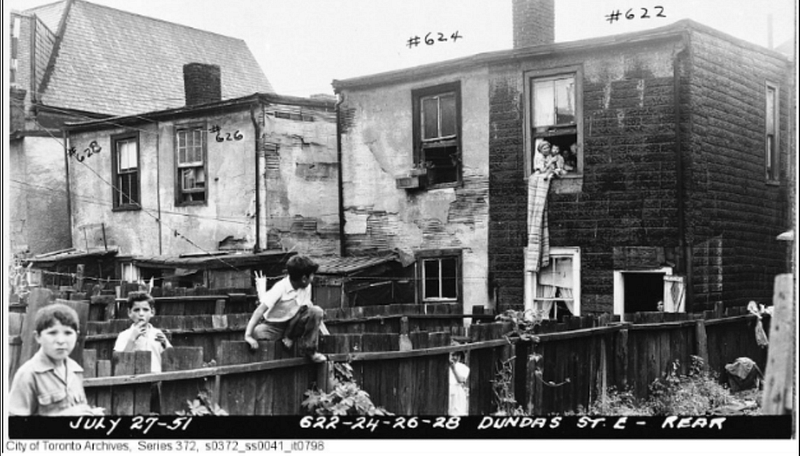
Disease spread easily. Infant mortality was high. They worked in factories, rail yards, and slaughterhouses — labouring hard for little and rarely thanked for it.
To be Irish in early Toronto was to be an outsider — deemed unruly, unhygienic, morally suspect. The same tropes were later recycled for each new wave of immigrants. And yet, over time, the Irish became indistinguishable from the dominant culture. They entered police forces, schools, parishes. Their names — once spat out in derision — became unremarkable. They were folded into whiteness.
But assimilation carries its own kind of loss. The grief remained — muted, internal.
My Irish ancestors were not enslaved, but they were disregarded. Not racially marked, but socially peripheral. Their trauma was absorbed into the architecture of Toronto: in the shadows of parishes, beneath the veneer of propriety, in the rituals of silence passed down across generations.
Even now, that grief lingers in our family — not dramatic, but heavy. An ache with no language. An inheritance of endurance.
On Recognition, or the Lack Thereof
I do not fit into boxes or categories. And increasingly, I wonder why I should.

The state rewards simplicity — identities that are legible, sortable, and statistically useful. But many of us are uncounted. We are not marginal by virtue of smallness but by virtue of being unclassifiable. Too complex to categorize. Too nuanced to reduce.
Canada prides itself on multiculturalism. And, in many ways, rightly so.
You can walk through parts of Toronto and hear five languages in a single block. Temples and mosques sit beside cathedrals and Caribbean churches. Spices from five continents mingle in one suburban plaza. There is a real and undeniable beauty in that, a quiet poetry in how difference can coexist. But it is also a bittersweet beauty.
Because multiculturalism, while rich in texture, is still built atop an older scaffolding — one shaped by empire, class, and the kind of suffering that doesn’t always translate across time.
Each community that arrived here passed through fire. The Irish, once scorned and confined to the industrial outskirts. The Italians, the Portuguese, the Caribbean people — each vilified before they were accepted. And some, like the Indigenous and Black Canadians, were never truly offered acceptance — only conditional toleration, reshaped with each generation.
What we celebrate now was forged from exclusion. From struggle. From persistence, not permission.
Multiculturalism today wears a kind face, but its foundation is uneven. Some cultures are celebrated, and others are merely tolerated. Some differences are marketed as diversity, while others are quietly filed under “too complicated.”
If your ancestry is straightforward and your pain is legible, you may be offered recognition — however shallow. But if you are like me — composite, ambiguous, plural — you are often met with discomfort, confusion, or silence.
We speak of representation as though it were a mirror. But what if your reflection has never appeared in it?
I have been told, gently but often, that I “don’t look it” — as though ancestry must be visually certified before it counts. I’ve sat in rooms meant for Black voices and felt unsure if I belonged, and in spaces of privilege, I’ve watched my family’s stories dissolve into assumptions. Even a well-meaning, “Where are you really from?” It‘s not a question of curiosity — it’s an audit of authenticity.
What does it mean to belong in a nation that cannot name you? To carry the echoes of grief, migration, war, and cultural fracture without the credentials of visibility?
What Comes After Categories
The stories I’ve inherited are not theoretical. They are not allegorical. They are honest — full of war, suicide, dispossession, institutionalisation, exile, resilience and survival.
From my Guyanese lineage, I inherit resilience and fracture — a capacity to endure despite dislocation and an intimacy with systems never built for us.
From the Irish, I inherit silence — the kind passed down not in language but in tone, in what is left unsaid around dinner tables, in the ache that manifests as obedience.
From the Dutch, a specter of power without protection — Proximity to institutions, but not their safety.
And from them all, a stubborn loyalty to survival — a kind of dignity carved between the lines.
But we are not only what we inherit. We are also what we choose to carry forward — And what we choose to lay down.
I have chosen to speak. I have chosen to claim my complexity, even when it makes others uncomfortable. And I have chosen to belong without asking permission — Because I know that identity is not a matter of approval, but of memory, voice, and presence.
To be Canadian should be enough. But it rarely is.
The state continues to reward simplification. It functions on clear data, not lived contradiction. And so, those of us with complex identities remain uncounted, unqualified, and unheard.
What if we built a country where identity was not measured by blood quantum but understood as the sum of lived experience, ancestry, and memory?
What if cultural legitimacy were not granted through skin tone or surname, but through one’s story — its honesty, its depth, its inheritance?
What if we made space for those who embody paradox — those who descend from both the colonised and the coloniser, who are shaped as much by silence as by survival?

What if we called that Canadian?
Because that is what I am. I am not a footnote in someone else’s nation-building exercise. I am its living text — unresolved, plural, and present. And I am not seeking admission. I am already here.
Amanda Breeze is a Canadian writer of richly layered ancestry – Guyanese, Irish, Dutch, Portuguese, and more. Her work traces the lines between personal memory and collective history, exploring what it means to belong when identity defies the margins. If her words moved you, you can support her work at ko-fi.com/abreeze.
Member discussion