


Table of Contents
In an era of polarization, revivalism, and authoritarian drift, the resurrection we need isn’t spiritual – it’s civic.

It’s Easter weekend for many.
But the tomb isn’t empty.
It’s crowded.
With false prophets, digital zealots, and the bloated body of a once-idealised republic, the stone was never rolled back. We just painted it red or blue and decided to call that resurrection.
Across timelines and ballot boxes, the same tired script rehashes: good vs. evil, left vs. right, saviour vs. heretic. We’ve become a civilization crucified on the cross of dualism, with each side convinced it is the risen one, the chosen one, the only one.
But what if the resurrection we need isn’t a return to religious dominance or political purity – but a rebirth of civic imagination?
Before the Cross: Easter, Empire, and the Origins of pernicious polarization
Easter did not begin with chocolate, churches, or Hallmark cards. Before it became the centrepiece of Western Christianity, it was a collision point of faith and empire, revolution and repression, hope and heresy.
Historically, Easter commemorates the resurrection of Jesus Christ – an itinerant Jewish teacher who challenged Roman imperial power and local religious orthodoxy. His execution was not just spiritual sacrifice; it was state-sanctioned violence. Crucifixion was Rome’s most humiliating, public, and politically strategic punishment, reserved for those who disrupted order. It was both a spectacle and a warning.
And it worked for a time. Until the narrative was inverted, the tomb was found empty, the veil was torn, and what was intended as silencing became the seed of a movement.
That movement, initially one of underground compassion, defiance, and radical equality, was eventually institutionalized, woven into empires, weaponized by kings and clergy, and codified into dogma.
The original Easter was an uprising of conscience. But as the centuries passed, that uprising was co-opted into control.
And here lies the paradox we still haven’t resolved: resurrection as resistance or reinforcement? The state and the soul have long wrestled for control of the story.
There is something tangible about what social identity theory upholds in the story of Jesus. We can choose to believe that Jesus taught us how and why to be moral or that tribalism genetically induced humans to adhere to biomarkers. Whatever reasons for the way we are, it still lays the groundwork and strongly reflects the nature of humans individually and collectively.
Political scientists have coined this term “pernicious polarization” to describe this dangerous civic fracture, where political identity becomes central to an individual’s sense of self. Any compromise is seen as a betrayal. Opposing views are seen as enemies, and institutions and corporations are either saviours or conspirators. These are not just disagreements; it is identity collapse.
Today, we can clearly see how political ideologies no longer sit aside religious ones but are woven intrinsically into the fabric of nations. Unlike healthy democratic contestation, pernicious polarization fuses ideology with emotion, party with personality, and disagreement with danger. It escalates any conflict by moralizing it. Political affiliation now bleeds into moral purity. Resurrection narratives begin to distort, where these stories of shared rebirth turn into righteous triumph over the damned.
The Politics of the Cross: How Martyrs Become Myth and Monsters Become Necessary
The crucifixion of Jesus was not an aberration – it was political theatre. Rome didn’t just execute him; it orchestrated a public demonstration of what happens to those who challenge the sanctioned order. His death, though framed in theological terms by later doctrine, was at its core an act of state violence legitimized by religious authority and carried out under the guise of public stability.
Martyrs, after all, do more than die – they define. And monsters, once conjured, make even the most draconian measures seem justified.
In this sense, Jesus was neither a saviour nor a saint to his contemporaries. He was a threat: healing without a license, preaching without a party, and challenging both empire and ecclesia. His death was an expedient choice – offered to the crowd in a moral binary. Barabbas or Jesus? Criminal or Christ? And, as ever, the crowd chose the familiar violence of the known over the disruptive possibility of the new.
That logic persists. Today, we frame our political struggles in terms no less mythic. Every electoral cycle becomes a crucible. Leaders are no longer administrators or flawed human beings – they are either anointed or heretical, saviours or destroyers.
Trump’s political rise followed precisely this arc. For some, he is a martyr – persecuted by institutions, betrayed by the media, and wronged by a corrupt system. For others, he is the monster incarnate, a symptom of America’s worst instincts come to life. In both renderings, his mythic function exceeds his policies. He becomes a symbol, not just a man.
Trudeau has undergone a similar arc in Canada. Once the progressive golden boy, he now finds himself derided as either a neoliberal fraud or a woke authoritarian, depending on who’s shouting. His compelling or flawed policies are often less important than the narrative into which he is slotted.
In Britain, Johnson’s populist performance as the affable disruptor gave way to the sobering realities of governance and scandal, yet his enduring symbolic role remains that of a martyr to the anti-establishment cause. Even Brexit was not just a policy but a passion play. The Leave campaign functioned as a resurrection fantasy, promising sovereignty through severance.
This is how ideology becomes idolatry. We no longer debate ideas; we defend messiahs. Every criticism becomes a crucifixion. Every opposition becomes persecution. The martyr cannot be questioned. The monster cannot be humanized. This is not politics. It is theology by another name.
We have seen, too, where this path can lead. Hitler, often imagined as an outlier of history, rose not through brute force alone but through spiritual rhetoric. He invoked God. He created a state-sanctioned version of Christianity – Positive Christianity – that merged Aryan myth, national destiny, and divine blessing. His propaganda depicted him as a Christ-like redeemer who would lead the German people from humiliation to triumph. Religion didn’t prevent fascism. It gave it robes and rituals.
The reemergence of religious nationalism in the West today is not simply nostalgic. It is strategic. The danger is not faith – it is the fusion of belief with state machinery. When courts are filled with judges who confuse divine command with civic law, when prayer replaces policy, and when dissent is recast as sin, democracy is no longer democratic.
This is why secularism was never meant to be anti-religion. It was a firewall – erected not to ban belief but to protect it from becoming doctrine by force. To allow for multiplicity. To make space for the nonbeliever and the devout alike. To keep resurrection a metaphor, not a mandate.
And yet, now, that line is blurring. Again.
The Machinery of Division: How Polarization Replaced Politics
Polarization did not arrive overnight. It calcified over decades, nourished by policy failures, cultural fragmentation, and the monetization of outrage. The United States’ roots stretch back to the Southern Strategy, the moral majority, and the Reagan Revolution, each contributing to the idea that political identity is not a matter of preference but of moral righteousness. Politics became spiritualized. To vote differently was not to disagree – it was to defect.
By the early 2000s, with the post-9/11 consolidation of power, Western democracies began sliding into a permanent state of ideological emergency. Surveillance was normalized. War was moralized. And partisanship metastasized. The 2016 U.S. election did not cause polarization – it simply revealed how far the center had collapsed.
But it didn’t stay in the U.S.
Canada imported the culture war.
Britain collapsed into it during Brexit.
France and Germany now wrestle with the rise of populism and political fundamentalism.
Even Australia’s cultural institutions have begun to mirror American-style rhetoric around race, gender, and freedom.
And yet, amid all this imported division, we fail to ask the deeper question: Why do we cling to polarization so tightly?
Perhaps because it offers moral clarity in uncertain times. In an era where institutions have failed, when capitalism feels extractive and democratic promises hollow, choosing any side feels like an act of agency. But this clarity is an illusion – a flattening, a manipulation.
Terms like “woke” and “fascist” now function less as descriptors than as tribal codes. They reduce people to teams, turning citizens into caricatures. One can no longer believe in climate action without being called a socialist, nor question vaccine policy without being branded a conspiracist. Even nuance is seen as betrayal.
This ideological sorting bleeds into everything: education, healthcare, parenting, art. The algorithm knows your side before you do. It curates your outrage accordingly.
And while we’ve been busy shouting at each other across the digital chasm, we’ve become blind to a deeper danger: We are beginning to resemble the systems we once opposed.
In the West, we pride ourselves on being the ideological opposite of authoritarian regimes like China or Russia. But surveillance capitalism, censorship-by-mob, and manufactured consent are not so different from state control. We do not need secret police when we have public shaming. We do not need to burn books when we algorithmically make them disappear. We have built our own panopticon and vote for it with our attention.
Meanwhile, the East, long criticized for its top-down control, now watches as the West recreates its mechanisms from the bottom up – voluntarily, performatively, and destructively.
Resurrecting the Social Contract
If resurrection is to mean anything in this moment, it cannot be symbolic. It must be structural. It must go beyond metaphors of awakening and confront the material conditions of collapse.
What we are witnessing across much of the Western world is not just political fatigue – it is a breach in the social contract itself.
Social contract dates back to Enlightenment thinkers like Hobbes, Rousseau, and Locke. It describes the implicit agreement between citizens and the state: in exchange for certain freedoms, people would receive protection, representation, and the fundamental dignity of shared belonging. At its best, the social contract is a covenant of trust – a foundation upon which true liberal democracy rests.
But that foundation is crumbling.
And not from neglect alone.
Across democracies, citizens have been asked to sacrifice more than they agreed to. Economic systems reward the few and exhaust the many. Healthcare is politicized. Education is under siege. Justice is dispensed unequally. Trust in institutions is threadbare. The state demands loyalty, obedience, and taxes – but fails to return a sense of collective security or future.
This is not merely dysfunction. It is a breach of promise.
Trevor Noah once described the social contract with devastating clarity. During the height of the George Floyd protests, he said, “When you see people looting, it’s not because they don’t respect the law. It’s because they believe the law doesn’t respect them.” This happens when the contract is broken: people begin to operate outside of it – not because they are lawless – but because they are unrepresented.
When enough people feel unrepresented, democracy becomes untenable – not because the concept is flawed, but because the covenant was never fulfilled.
To renew that contract will require more than electoral reform or policy tinkering. It will require a resurrection of the political imagination – a shift in how we relate to each other, the state, and the future.
That means creating a system where people don’t have to choose between ideology and survival. Where disagreement is not demonization. Where public discourse allows for contradiction and ambiguity. Where the center is not empty but expansive.
We must remember that the contract we seek to restore isn’t just civic. It’s relational. It’s about how we live with one another, how we listen, how we forgive, and how we build.
If we cannot restore the conditions for belonging, we will revert to the logic of blame.
Once we do that, it will no longer be a contract.
It is a war.
Ascension Post-Civic Resurrection
Where political identity becomes an existential marker, and every disagreement is interpreted as betrayal, it means moving beyond pernicious polarization. If the social contract is to be rewritten, it cannot be through erasure or dominance – it must be through imagination, through new terms of coexistence.
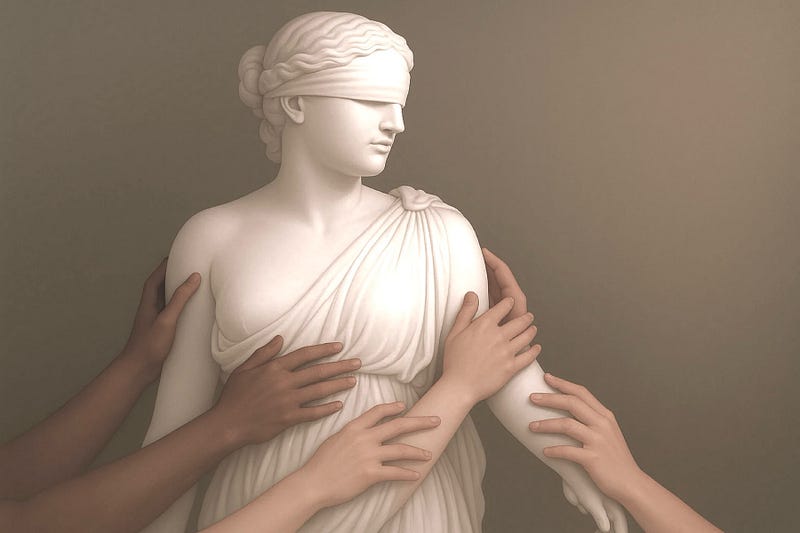
What would this look like?
It would require a recommitment to pluralism, not as a euphemism for tolerance, but as an active discipline. We must re-learn how to hold contradictions, debate in good faith, and treat disagreement as necessary rather than dangerous. This doesn’t mean surrendering moral clarity – it means refusing moral tribalism.
It would involve reforming institutions to reward nuance rather than performance. That includes journalism, which must abandon the false equivalence of “both sides” while resisting the temptation to act as ideological enforcers. It includes electoral systems, which in countries like the U.S. and Canada remain rigged to amplify the loudest extremes and ignore the exhausted majority.
It would call for media and digital platforms to take responsibility for how polarization is manufactured and monetized. We must question what we consume and how it’s shaped. Algorithmic outrage is not an accident. It is infrastructure.
Lastly, it requires us to develop civic humility. That means allowing room for people to evolve politically. For past beliefs to be shed. For complexity to be lived rather than just tweeted. If we do not allow transformation in others, we cannot claim to believe in it for ourselves.
Civic resurrection isn’t about returning to a mythical golden age. It’s about becoming something new. Something more durable. It’s about creating a political culture that doesn’t need martyrs or monsters to function – but citizens. Whole, contradictory, searching citizens.
We will not resurrect democracy by pretending it hasn’t died in parts. We will only do it by mourning the loss honestly and rebuilding deliberately – with conversation, disagreement, and grace.
Resurrection is not passive. It is not inevitable. It is not gentle.
It is an act.
Rolling the Stone Ourselves
Resurrection cannot be divine intervention if it is to mean anything now. It must be human insistence. The tomb does not open independently, and the stone does not roll away by miracle. Someone must move it.
We must recognize what lies buried: the belief that politics can be redemptive, the idea that complexity is strength, not betrayal, and the fragile hope that people, unlike us, are not our enemies but our partners in survival.
None of these truths are fashionable right now. They don’t trend. They don’t raise money. They don’t win elections. But they are the only way forward.
I believe nations can heal the same way individuals do – not through denial or nostalgia but through honest confrontation, looking at what is broken without turning away, and collective, often uncomfortable labour.
Resurrection doesn’t erase wounds. The body still bears them. The scars remain visible. That is the point.
We are not meant to be untouched by history but transformed by it.
And perhaps that is the greatest heresy of our age: to believe that resurrection is easy. That the stone will roll back by itself. That someone else – another saviour, another cycle – will carry the burden for us.
But no one is coming.
There is only us.
And if we do not rise – coherently, courageously, collectively – we are not witnessing a resurrection.
We are living in regression.
About the Author:
Amanda Breeze is a Canadian writer, radical centrist, and philosophical mother of two whose work explores identity, inheritance, and the power of nuance. Her writing has been featured and boosted on Medium. She believes rebirth is always possible – but never automatic. If this piece moved you, you can support her work at ko-fi.com/abreeze.
Member discussion