


Table of Contents
Ancestry adrift, exile by sea, the maritime memory that shapes a life

“The sea is history.” – Derek Walcott
The truth is this: I come from water.
Not the gentle kind, not the cool, almost chilling bodies of Canadian lakes, docile and blue – but the kind that swallows men whole. The kind that carries the weight of empires in its tide and pulls memory from the seabed up like wreckage.
When you’re young, you have short bursts of vividness; memories float in your mind like bubbles. They grow and grow and pop, they disappear. Time and time again, I remember being in a shoreless lake. I remember bobbing up and down, kicking as much as a child could, an innate fear to keep my head above water. My mother was by my side as we watched the boat retreat. For whatever reason, the memory still lingers with this strange sense of abandonment and fear.
My mother was an excellent swimmer. Unbeknownst to my childhood comprehension, she had been a lifeguard through her teen years. She would tote us along to pools and lakes of Canadian beaches made of pebbles and coarse sand. Something had always called her to the water. To this day, she displays sands from beaches she’s vacationed to, frames sea creatures of different shapes and sizes, and fills vases with sand, pebbles, urchins, and shells from coasts across the Caribbean.
We were always by a body of water. My mother loved visiting places where everyday worries would vanish under cool summer breezes, and I loved being on those beaches. I would fantasize when I grew up that I would have a lake house or an ocean-side view. A house with a large wrap-around fence, withered by the sea. I could open any window and hear the water’s lullaby. I’d envision stepping off the back porch and feeling sand on my heels as I step out onto the shoreline.
The sounds of waves remind me of those fantasies. Even before those could become reminiscent, Gramma Leonie would rewind the tapes in her apartment on the nights I would sleep over. Casettes filled with waves crashing on Cinque Terre’s shores, white caps thrashing in on themselves. We’d lie in her bed, the street lights painting the ceiling of her apartment with interchanging shades of blue and white. I would slip into dreams of voyages to faraway lands. Those tapes were also her favourite.
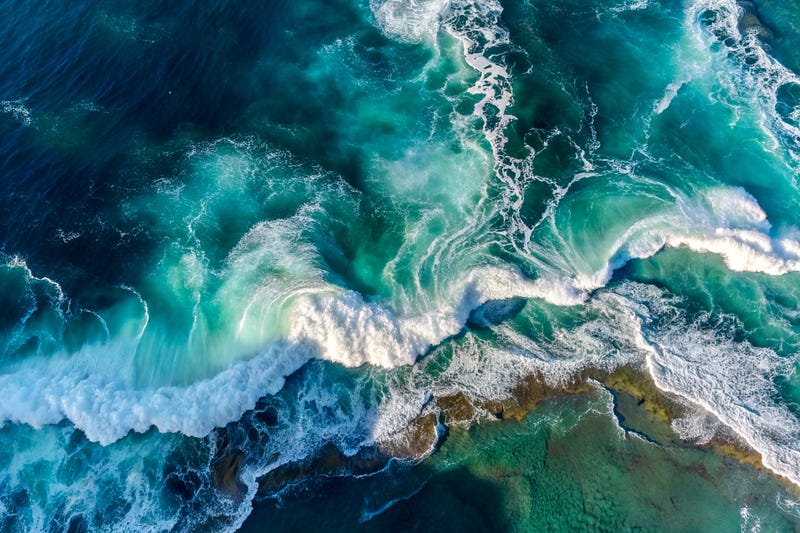
Though water has always brought those fond memories, I still fear the murky shades of greens and dark blues. The shoreline has always been different than the sea. I’ve been drawn to that edge, as if the sirens have always been calling.
Equatorial Waters
As a girl, I stood at the ocean’s edge, no idea it already knew me. Visiting the ocean was a ritual with my grandparents, and the fears and mysteries of the deep would subside. Almost every Sunday was a return to this place of beauty and beast. I would walk to the sand’s edge, where the foam would flow over my feet and rhythmically retreat, slow, majestic hymns of the ocean’s whispers. I felt its wind push across my face, misting droplets of salt across my face and lips. The only thoughts were of waves and wonder. The sea had already spoken to my blood. It carried the stories no one told me, the ones too heavy for family gatherings or family lore – the ones that lived in silence until they rose, unbidden, with the tide.
The stories unfolded the journeys of my blood, riddled across the vastness of the blue equator – a Portuguese line traced across the tides of the Atlantic. The Portuguese blood in me-what little of it was named – came too by that same abyss. Indentured servants, displaced by colonial debt and false promises, were brought to Guyana after slavery’s supposed abolition. They were not chained, but they were not free. Bound by contracts, they could not read; on lands, they could not claim; they lived and died between empires, between lands filled with endless water.
Guyana is no stranger to the sea. Their house was built on stilts, like every other house in Georgetown. To be Guyanese means to build your home on sea floods. To expect your foundation to be impermanent, ever-changing, on any whim. The landscapes are forever changing, geologically, emotionally, and politically.
My grandfather left in the middle of the night, the hush of his exile louder than thunder across the heat of the Caribbean blue horizon. He had once been close to Forbes Burnham – too close, perhaps – and when Burnham’s power turned vindictive, my grandfather vanished aboard a ship, his absence a protective act, a shield against assassination. He left behind his wife, four children, and homeland, slipping into the Caribbean Sea like a fugitive soul trapped by the siren’s call. He worked ships, crossed straits, and docked in unfamiliar harbours for a year. When he found Tortola, it was not paradise. It was a possibility. It was hope.

The island summoned by the gods of the sea, pushed up to the sky as if to break up the shades of blue from sea to sky. Tortola was a lush rainforest, a paradise island surrounded by blue from all sides. He then summoned my grandmother, who had been sent to Massachusetts, and called for their children, scattered like ink stains on a maritime map. They lived as sea-split people for five years, rebuilding a home in the hushed eye of the hurricane belt.
But even before my grandfather fled, the ocean had already claimed one of us.
Cartographers of the Sea
My great-grandfather was a Danish Jew from Suriname who carried salt in his veins and scripture in his coat pocket. He worked the ships that cut across the Atlantic during a century when the world tore apart and then tried to stitch itself back together with blood. Somewhere between the Netherlands and the New World, he fell in love with my great-grandmother – a Black woman in Guyana with skin like the earth after rain and eyes that knew too much.
They had little time. The ship would not wait for romance, and war waits for nothing. So he asked his captain, an Adventist man with more faith than formal training, to bless their union aboard the vessel. It was a marriage of prayer and urgency. There was no legal document, no photograph, just two people who bound themselves across race, nation, and ocean boundaries.
He sailed away, not knowing if she was carrying his child.

He never returned. The ship was torpedoed during the Second World War somewhere in the unmarked depths northwest of Martinique, where no stone marks the dead, only coordinates of a sunken ship filled with lost memories. He became one of the countless souls the sea absorbed without fuss – no grave but water, no memory but blood. And so my lineage folds into the long history of men claimed by salt and steel and women who raised children with ghosts beside them.
But the ocean doesn’t keep only our men. It keeps their memories.
Long before the ships that carried my grandfather to Tortola or my great-grandfather into war, there were other ships – nameless, rotting, crowded with bodies that were treated as cargo. My Black ancestors were chained below deck, crammed into darkness and defiance, crossing the Middle Passage not as voyagers but as commodities. Packaged like sardines, many did not survive the crossing. Some became the sediment. Others, like my foremothers, survived with salt-soaked lungs and generations of strength they’d be forced to spend.

Our tithe to the Sea
These are the tides I come from. My ancestry is not a line – it is a confluence, a collision of waves: Jewish and African, Portuguese and Dutch, Black and Brown and salt-washed wounds. The ocean is not a metaphor for me. It is the medium of transmission. It’s how the oceans become the sea, where the water pushes destiny.
My blood remembers. My bones carry the weight of hulls and hurricanes. When I stand at the edge of the Atlantic, I am not looking at scenery – I am looking at an incredible blue archive – an archive of manuscripts, libraries of what will never be said.
I may live far from the sea, but it always finds me.
When I bathe my daughter, I watch her cup water in her palms as if it’s sacred, I think of the grandmothers who held children at the edge of oceans – hoping they would not be taken or praying they would survive the crossing. When my newborn son flinches in his sleep, I wonder if even he dreams of the tides.
I never told them these stories – at least, not yet. But sometimes I think they already know. Maybe memory is not always passed through words. Maybe it’s passed through salted memories, seasoned on our bones, and seared into our lineage.
I feel it most when I am near water. Lakes will do, but they are not the same. They are too still, too polite. I was raised in Canada, a land of order and frozen restraint, but my body remembers a different rhythm. My blood carries tide; it aches for the coastline, the line between order and chaos.
When I write, I listen for the undertow in the language. When I speak, I feel the pull of distant shores. I am a mother now and a vessel – one more ship in a long line of crossings. I am not what my ancestors expected, but I am what they made possible.
And if the ocean remembers what we forget, let this be a remembering. Let this be the salt that seals the wound, the story that does not drown.
I used to think legacy was fixed; something passed down like land or name. But now I know: legacy is tidal. It comes in waves. Sometimes, it recedes, revealing forgotten ruins. Sometimes, it crashes so hard that it remakes the shore. My family’s history is not linear – it drifts, floods, and resurfaces. It shapes the soil we walk on and the floor we cannot see.
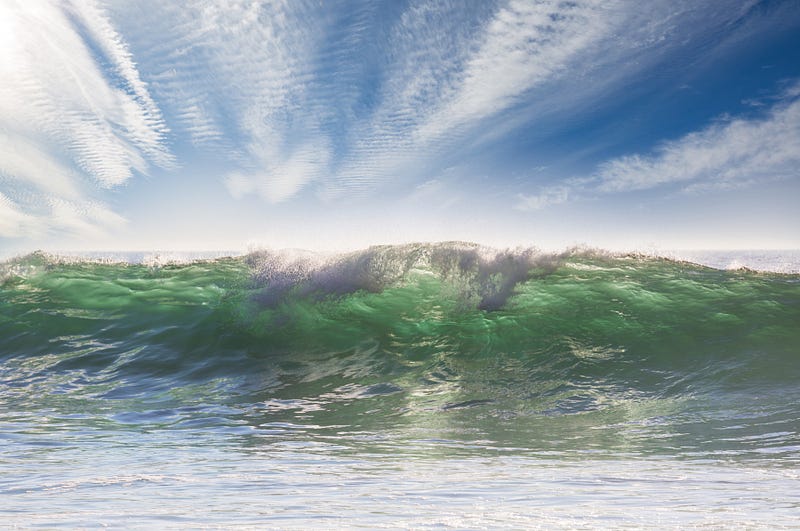
And maybe that’s the lesson of saltwater blood: that we are shaped by who we come from and how we endure their leaving. We are vessels, but also cartographers, drawing maps from memory, stitching continents with story. And so I write not to explain the ocean, but to enter it, to offer my voice to the current.
About the Author
Amanda Breeze is a Canadian writer and multidisciplinary creator whose work explores identity, ancestry, migration, and memory. She is of Portuguese Guyanese, Dutch Surinamese, Black Guyanese, Irish, and English descent – lineages that inform her deep engagement with diasporic inheritance and cultural complexity. Through A Breeze Studio, she develops essays, visual storytelling, and educational content that bridge the personal and the political. Her writing is known for its lyrical clarity, historical resonance, and philosophical nuance.
Follow Amanda for more writing on legacy, belonging, and the stories hidden beneath our names. To read more essays or explore her creative work, please check out her medium page.
Member discussion