


Table of Contents
From my daughter’s question about the sky to my baby’s first splash of water, I’ve been learning that parenting is less about answers than protecting curiosity itself.
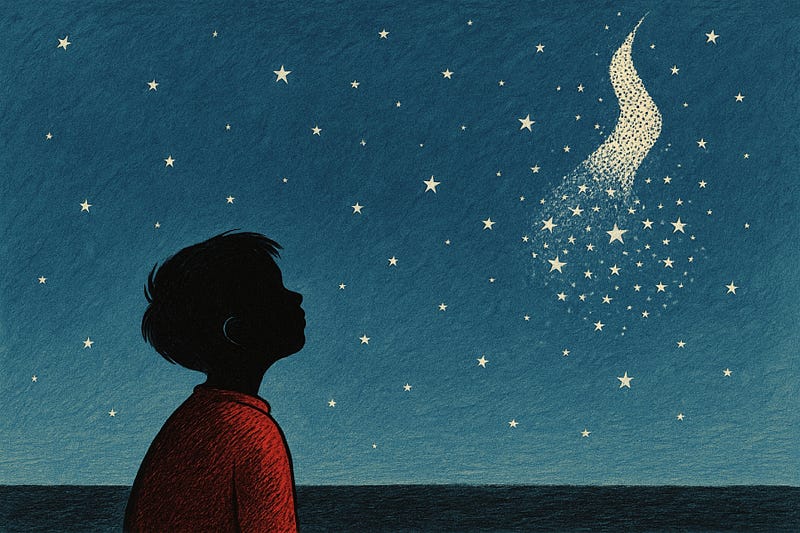
My daughter once asked me why the sky doesn’t fall. Not in the sense of clouds or storms, but the whole of it: the blue dome, the stars, the weight of space itself. Her words startled me like an expected storm. Behind them was not ignorance, but recognition: that the world rests on mysteries far greater than any one of us can solve.
I held my infant son in my arms as she spoke, his fingers still curling around mine in reflex, not yet reaching for the world. Between the two of them stretched a horizon: one child learning to name the questions, the other still made entirely of them.
Wonder is oxygen. And we are living in an age that forgets to breathe.
We have built a culture that prizes answers over questions, and speed over pause. Certainty over awe. Algorithms anticipate our desires before we’ve named them. Classrooms drill facts into children who once sang out their astonishments. Even parents, pressed for time and exhausted, too often will trade curiosity for efficiency. “Because I said so” is faster than “What do you think?” But in that trade, a flame goes out.
The Vanishing Breath
Developmental psychologists have measured what parents already sense: between ages four and six, children reach their peak in asking questions, hundreds per day, a relentless cascade of “Who, What, Where, Why and How’s”. Why is the moon following us? How does a shadow grow? Where does the water go when it disappears? But once they enter school, the curve collapses. By middle school, the average child asks only a handful of genuine questions in an entire day.
My eight-year-old daughter has begun to check herself before speaking, to hesitate before voicing the wild questions that once burst from her. When she does ask, I try not to rush. Sometimes we stand together by our terrarium, watching condensation bead on the glass. “Is the moss sweating?” she asks. It would be easy to explain: it’s evaporation, humidity, microclimates. But better, I’ve learned, is to ask her back: “What do you think?” Then the room fills with possibilities: the moss is alive and thirsty; the terrarium is a tiny sky making its own rain.
This is the real danger: not that our children will lack answers, but that they will stop daring to breathe the questions aloud.
Science as Sanctified Wonder
Every great scientific revolution begins with a disobedient question. Galileo tilted his telescope skyward and asked whether heaven was as perfect as priests insisted. Darwin traced the beaks of finches and asked whether creation might unfold through time. Rosalind Franklin’s photographs asked whether life’s code was not written in words but in spirals of light.
Science is not the possession of answers. It is the courage to ask better questions, questions that pierce habit, unsettle dogma, and open the air again.
Children know this instinctively. When my baby smacks his palm against water in the bathtub, watching droplets scatter like diamonds, he is running the first experiment of the human race: what happens if I touch the world, and the world touches back?
Parenthood as Laboratory
To raise a child is to enter a laboratory where every hour presents a new hypothesis to test. Why do ants march in a line? Why does thunder sound like the sky is breaking? Why do some people have more and others less?
My daughter once told me that the prayer plant’s leaves “turn their faces” to the sun the way she does on summer mornings. I almost corrected her with words like phototropism, but I stopped myself. Because in her phrasing, there was no error, but poetry. The kind of observation we as adults too often forget.
Parenting is not about distributing correct answers, like sealed envelopes. It is the slow tending of questions until they burn bright enough to guide their own path.
This tending is political. For what kind of future waits for a generation that stops asking? Authoritarians depend on silence. Corporations depend on passive consumption. Only those who practice wonder can resist. Only a child who has been allowed to doubt, to imagine, to experiment, will grow into an adult who can build something new.
The Fragile Architecture of the Brain
When my daughter was still small enough to be craddled in my arm, I wrote a letter to my grandmother. I had been reading about early brain development. Those astonishing first three years are when billions of synapses spark and fuse, when neurons fire like constellations being mapped for the first time. A quarter of the hundred billion cells we are born with bind into networks during that brief window. Afterward comes pruning: the brain quietly shears away unused synapses, leaving only the connections reinforced by experience. “Use it or lose it”, that was the phrase the article used. The brain, like a gardener, weeds its own garden for the sake of efficiency.
What struck me then, and still strikes me now, is how absorbent the young mind is, how it takes in every surrounding as material for its internal architecture. Makes our digital age feel perilous. Too many parents, weary and overburdened, hand their infants an iPad or phone as a pacifier. The brain learns from whatever it is given. Neurons fire for bright, flashing images the same way they fire for the turning of a page or the gaze of a parent’s eyes. Yet the kind of connections being made differ profoundly. Screens offer instant reward, shallow feedback loops. Books, play, and unstructured boredom cultivate patience, narrative, and creativity.
Even then, I feared what I see more clearly now: that books are being outcompeted by YouTube clips, by algorithmic “learning” modules, by the narcotic flicker of endless videos. Where I live, even grade-schoolers are already tethered to laptops. It becomes harder each year to convince a child that a novel offers greater treasure than the dopamine surge of a screen. And that recognition filled me with a sadness I carried straight into my letter: the sense that if we do not guard wonder in the early years, we may lose it forever.
The Alchemy of Wonder
So how do we teach children to breathe wonder in a world designed to suffocate it? The work is less about providing answers than about creating space for exploration.
• Ask “What if?” instead of “That’s just how it is.” Let a child imagine the sky falling. Let them propose wild mechanisms to hold it up. Correctness is overrated; imagination is foundational.
• Experiment in the ordinary. Grow seedlings on a windowsill and notice how they bend toward the light. Watch water bead on a terrarium wall and wonder aloud if it’s sweating. Science is everywhere, hidden in plain sight.
• Model questioning. When I admit to my daughter, “I don’t know – let’s find out,” her eyes light up. She learns that ignorance is not shame, but invitation.
• Protect the slow. Wonder requires time. A hurried life strangles curiosity. Guard unstructured hours as fiercely as homework or chores.
Wonder is not a gift bestowed by genius. It is a skill, like a muscle, that strengthens with use and atrophies with neglect.
Return to Breath
I return often to my daughter’s question about the sky. There is, of course, an answer: gravity, atmosphere, the balance of forces. But the answer is not the point. The point is that she looked upward, saw the dome above, felt its weight pressing down, and dared to ask aloud what so many of us forget to wonder.
That is the breath we must not lose.
For wonder is the oxygen of science, of democracy, of the human spirit. Without it, the intellect suffocates; the civic body grows brittle; the imagination withers. With it, we endure mystery, resist lies, and build futures larger than ourselves.
To raise children in wonder is not to prepare them for exams or careers, but to instill in them a lifelong love of learning. It is to prepare them to bear the weight of freedom.
Perhaps the task of parenting is not to give children all the right answers, but to guard the flame of their questions, until the day they can carry it into the dark themselves, lighting paths we cannot yet see.
Wonder is the oxygen keeping that fire alive.
About the Author
Amanda Breeze is a Canadian writer and mother of two. She writes about parenting, science, recovery, and the inheritance of wonder.
Member discussion